So you’ve bought a Tesla, sold one, or you’re relocating across the country. Either way, the car needs to get there — and you won’t be the one driving it. Now you’re staring at a screen full of half-answers. Forum threads argue over “Tow Mode,” charge percentages, and whether an open carrier will leave your paint gritty with highway dust.
Take a breath. Tesla transport in Australia isn’t nearly as complicated as those threads make it sound. It just works a little differently from shipping a petrol hatchback. Get a few details wrong, though, and pickup day can turn stressful fast.
This guide covers what a Tesla owner actually needs to know about Tesla car transport in Australia in 2026. You’ll learn how it differs from ordinary vehicle shipping, and how to prep your car before the carrier arrives. You’ll also see what Tow Mode is really for, and how re-registration works when you cross a state border.
What Makes Tesla Transport Different From Ordinary Car Shipping?
At a glance, loading a Tesla onto a car carrier looks like loading any other vehicle. The crew drives it up the ramp, positions it, and ties it down. The differences show up in the details.
There’s no idle engine for a loading crew to listen to. An experienced operator reads the touchscreen and dash warnings instead. They use those signals — not engine noise — to judge how the car is behaving.
The battery pack sits low and flat along the floor. That shifts the car’s centre of gravity and adds meaningful weight compared with a similarly sized petrol car. Loading crews need to factor that in when they load and secure it.
Several Tesla models also sit lower to the ground than the SUVs and utes that make up most everyday freight. That means ramp angle matters more than it would for a jacked-up 4×4.
Then there’s the tech, too: an electronic parking brake and a touchscreen gear selector. For most owners, a phone doubles as the primary key. None of it makes the car harder to move. It does mean the crew should already be comfortable around EVs, rather than figuring things out on the day.
Open vs Enclosed Transport: Which Suits a Tesla?
Both move plenty of Teslas around Australia every week. The right choice usually comes down to the trip, not the car.
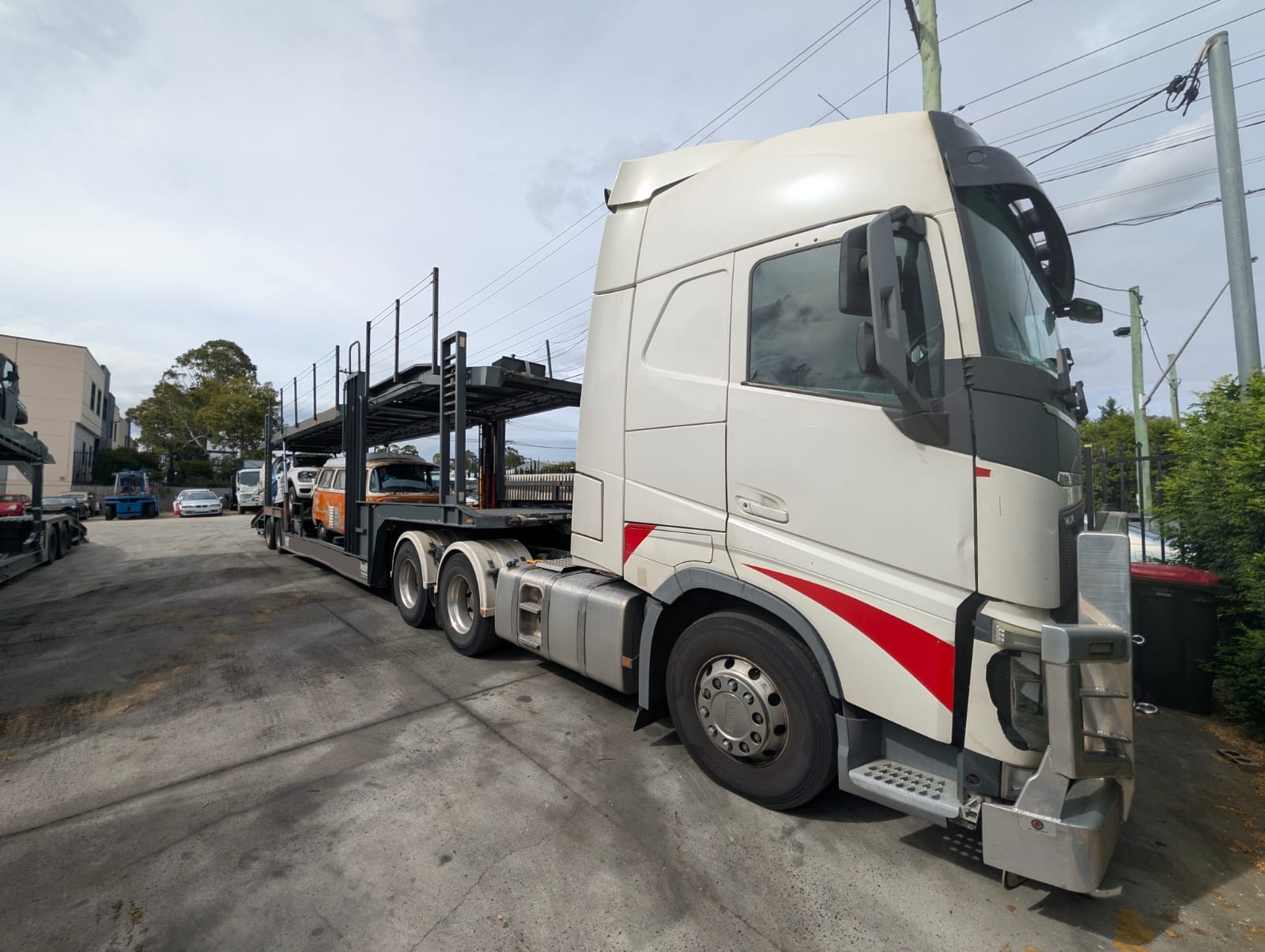
Open transport is the standard option for most interstate relocations. Your Tesla travels on a multi-car carrier alongside other vehicles. Crews secure it using standard tie-down methods from across the industry. For a car in good condition on a well-travelled route, that’s a perfectly sound choice.
Enclosed transport adds a solid roof and walls between your car and the weather, road spray, and dust. Owners tend to choose it for a brand-new delivery, or a car they’re keeping in near-showroom condition. It also suits a long trip through dust or coastal salt air, or simply extra peace of mind. Neither option is universally “better” — it’s a trade-off worth discussing with your provider before booking. Our interstate car transport service can talk you through which setup suits your route.
Interstate Tesla Transport: Routes, Timing and What to Expect
Tesla ownership has spread well beyond the postcodes where it started. Interstate relocations now run in every direction, not just along the Sydney–Melbourne–Brisbane corridor. Buying interstate, relocating for work, and sending a car ahead of a family move are all common reasons owners book a carrier. Most would rather do that than drive the car themselves.
Transit time depends on distance, route, and how the carrier schedules its network that week. It’s worth asking for a realistic delivery window rather than a fixed date. Most car carriers run multi-stop routes, not a single dedicated trip. A good provider keeps you updated along the way instead of leaving you guessing. For a full look at how the process works end to end, check our vehicle transport services page.
Re-Registering Your Tesla After an Interstate Move
If you’re relocating permanently, you’ll typically need to register your Tesla in your new state within a set window of arrival. That window varies by state. Service NSW requires registration as soon as you keep or garage a vehicle in NSW. South Australia’s transport authority gives newly arrived residents a few months’ grace before local registration becomes compulsory.
Expect to need a roadworthy inspection, proof of identity, evidence of ownership, and any applicable transfer fees. The exact mix differs by state, so check with your local road authority directly. If your Tesla sits unregistered for any part of the journey, separate rules apply. Our guide on transporting an unregistered vehicle in Australia explains the rules.
Your Pre-Pickup Checklist
A little prep makes pickup day faster for everyone. Before the carrier arrives:
- Charge level: No need for a full battery. A partial charge is usually enough. It lets the car drive itself on and off the truck and keeps the touchscreen responsive.
- Bring the key card: Phone-as-key only works with your paired device — no good for a driver who isn’t you. Leave the physical key card with the vehicle.
- Consider Valet Mode: It limits speed and acceleration, and locks the glovebox and frunk. That’s handy if you’d rather keep certain compartments private.
- Clear out personal items: Toll tags, garage remotes, permits, and loose belongings should come out before handover.
- Check tyre pressures: Correct pressure makes loading smoother and gives an accurate baseline for the condition report.
- Photograph the car: A quick, timestamped set of photos before handover gives you a clear reference point. Most reputable providers do the same at pickup and delivery.
- Remember Sentry Mode: Left active, it keeps recording throughout the process. That adds an extra layer of documentation on top of the carrier’s own checks.
Tow Mode Explained
Most relocated Teslas are fully driveable. A crew member simply drives it up the ramp, under the car’s own power. You won’t need a special mode. Tow Mode only matters if a vehicle can’t move itself, say because of a flat battery or mechanical fault.
According to Tesla’s own vehicle transport guidance, you activate Tow Mode from the touchscreen: Controls, then Service, then Towing. It releases the electronic parking brake, so a crew can safely winch the car onto a flatbed.
Tesla is explicit on one point: never flat-tow its vehicles for any real distance. Flat-towing means dragging the car on all four wheels behind another vehicle, and it can generate damaging heat in the motor. That’s a towing scenario, though — not standard car-carrier transport. On a carrier, the crew drives or winches the vehicle aboard, and it travels with all four wheels off the ground.
If the battery is completely flat, the front trunk still helps. It houses a manual jump terminal. An experienced crew can use it to wake the touchscreen long enough to release the brake.
For a healthy Tesla, transport day looks like it does for any other car. Tow Mode is simply the safety net for the occasional vehicle that can’t drive itself aboard.
Charging Up Once Your Tesla Arrives
One upside of relocating within Australia rather than importing from overseas: you’re arriving into an increasingly mature charging network. Tesla’s Australian Supercharger footprint has grown quickly, passing more than 150 sites nationwide in early 2026. Coverage now extends well beyond the capital cities.
Home charging and a growing number of public AC destination chargers add to that network. Together, they make settling a Tesla into a new city usually painless. It’s worth a quick check in the Tesla app for nearby options before the car even arrives.
Is an EV Battery Treated as Dangerous Goods?
It’s a fair question, given how often lithium-ion batteries come up in dangerous goods discussions. Loose cells and standalone battery packs do fall under Australia’s dangerous goods rules for road transport. Think of the ones retailers or recyclers ship. In practice, though, those rules target standalone battery shipments, not a complete, roadworthy vehicle.
When a crew drives or winches your Tesla onto a car carrier as an intact car, it travels as vehicle freight. That’s the same as any other passenger car on the truck. If your vehicle has been in an accident and the battery’s condition is uncertain, say so. Flag it directly with your transport provider before booking.
Insurance and Paperwork Worth Double-Checking
Before your Tesla leaves your hands, confirm a few things rather than assume them:
- Your provider carries insurance that covers the vehicle in transit, and you understand what it includes.
- The crew completes a written condition report, ideally with photos, at pickup and matches it at delivery.
- You have your registration papers, proof of ownership, and VIN details ready for any interstate re-registration.
- Your own comprehensive policy has no gaps around interstate transport. Most policies don’t, but it costs nothing to check.
Our FAQ page covers the questions we hear most often from customers moving vehicles interstate.
Choosing a Tesla Car Transport Provider in Australia
Not every car carrier handles EVs the same way, so it’s worth asking a few pointed questions before booking:
- Do their crews have genuine experience with EVs — electronic parking brakes, key cards, low-clearance loading?
- Do they insure the vehicle for the full journey, in writing?
- Will you get real-time updates rather than a single delivery-day phone call?
- Do they communicate clearly, right from the first quote? A provider who explains the process upfront usually handles surprises well too.
At Unicorn Car Transport, we handle interstate vehicle transport — EVs included — every day across Australia. We insure every journey and track it in real time. We treat each handover like the car on the truck is the only one that matters. Ready to move forward? Request a free quote or get in touch with any questions first.
Frequently Asked Questions
Do I need to fully charge my Tesla before transport? No. A partial charge is usually enough. It lets the car drive on and off the carrier and keeps the touchscreen active. There’s no need for the extra weight or time of charging to 100%.
Can you transport a Tesla on an open car carrier? Yes — open transport is the standard method for most interstate Tesla relocations in Australia. Enclosed transport offers extra weather protection but isn’t a requirement.
Do I need to activate Tow Mode for a routine interstate move? Not if your Tesla is driveable — the crew simply drives it onto the truck like any other vehicle. They only use Tow Mode when a car can’t move under its own power.
Is a Tesla’s battery treated as dangerous goods during transport? An intact, roadworthy Tesla travels as a standard vehicle, not a battery shipment. Dangerous goods rules target loose cells and standalone battery freight, not a complete car on a carrier.
How long does interstate Tesla transport take? It depends on distance, route, and the carrier’s schedule that week. Ask for a realistic delivery window rather than a fixed date, since most carriers run multi-stop routes.
Do I need to re-register my Tesla after moving states? If you’re relocating permanently, yes. Most states require registration within a set window after arrival. Requirements and timeframes differ by state, so check with your local road authority as soon as you know your moving date.
Final Thoughts
Transporting a Tesla across Australia isn’t fundamentally different from moving any other car. It just rewards a little EV-specific know-how at pickup and drop-off. Get the charge level right, hand over the key card, and work through your pre-pickup checklist. Then book with a provider who already knows their way around an electronic parking brake. The rest tends to take care of itself.
Planning a Tesla relocation anywhere in Australia? Get in touch with Unicorn Car Transport and we’ll walk you through exactly how the process works for your route.