
You’ve just picked up the keys to a Porsche 911 in Melbourne. Home is Perth. Or maybe you’re relocating for work. There’s no way you’re driving your Bentley across the country just to reach the new house. Either way, one question keeps coming up: how are luxury cars transported interstate? And how do you avoid stone chips and gravel rash along the way?
It’s a fair thing to worry about. A prestige car is never really “just a car.” It’s a financial asset. It’s usually a piece of engineering you’ve researched for months. For plenty of owners, it’s a genuine passion project too. Before you hand your keys to anyone, it helps to know what actually happens between pickup and delivery. Not the glossy version. The real mechanics of it.
The Short Answer
Purpose-built car carriers move luxury cars interstate. Some are open, multi-level transporters. Others are fully enclosed, weatherproof trailers. Loaders use hydraulic lift gates or extended, low-angle ramps, so nothing scrapes on the way up. Crews then secure the car with soft strap or wheel-net restraints. They never use chains bolted near the chassis or suspension. The carrier takes a pre-transport condition report, usually with timestamped photos. Dispatch tracks the truck for the whole journey. At the other end, the driver hands the car over against that original report. For high-value, modified, or low-clearance vehicles, most Australian carriers treat enclosed transport as the standard choice on interstate routes.
That’s the summary. Here’s what each part of that process actually looks like.
Open vs Enclosed: The Two Ways Your Car Actually Travels
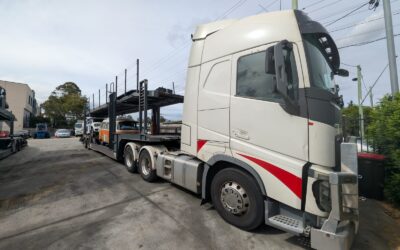
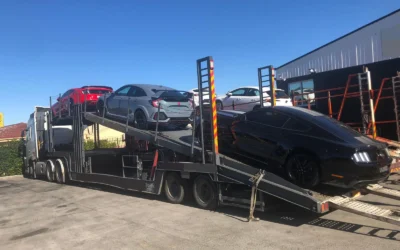
Most vehicles in Australia travel on open carriers. You’ve seen them — long, double-decker trailers carrying six or eight cars along the Hume or the Bruce Highway. They’re common for a reason. They’re efficient, well-tested, and they suit most cars on the road.
Enclosed carriers work differently. Your car sits inside a fully covered trailer. It’s shielded from rain, UV, dust, and stray debris from the trucks around it. Enclosed transporters usually carry far fewer vehicles at once, sometimes only one or two. That means less handling, fewer stops, and a lot more attention on how your specific car sits and travels.
Want the full case on why this matters? Read our guide on how high value vehicle transport protects luxury and prestige cars. We won’t repeat it here. This article covers the how — the exact process a transporter runs with your vehicle, step by step.
What Actually Happens From Pickup to Delivery
1. Vehicle assessment before the truck ever shows up
A good transport operator asks questions before booking anything. Is the car lowered? Does it have a front splitter or a low front lip? Does it run an aftermarket alarm or immobiliser? These details matter. They decide which truck goes out, whether the crew needs extended ramps, and how the driver approaches the loading angle.
2. A proper condition report
Before your car touches the truck, the crew photographs it. Panel by panel, wheel by wheel, interior included. This isn’t box-ticking. It’s the reference point for later. If a mark shows up that “definitely wasn’t there before,” both reports settle it. Reputable operators do this at pickup and again at delivery, so you can compare both reports side by side.
3. Loading, without drama
This is where low-clearance cars separate the professionals from the amateurs. Standard ramps create a steep angle. That angle can scrape a front splitter, crack an exhaust tip, or bottom out a lowered suspension in seconds. Specialist carriers use hydraulic lift gates or extended racing ramps instead. These keep the car close to horizontal as the lift raises it into position. No steep incline. No undercarriage drama.
4. Securing the vehicle correctly
Once your car is in position, it needs to stay exactly there for the whole trip. No part of the restraint system should touch bodywork or suspension components it shouldn’t. This is a genuinely technical part of the process. National standards govern it, not guesswork. The National Heavy Vehicle Regulator’s Load Restraint Guide sets out the accepted methods for restraining vehicles as freight. It also covers the difference between tie-down and direct restraint systems. That’s essentially the technical backing behind soft-strap wheel restraints, and why experienced carriers avoid chains hooked around a chassis rail.
5. Real-time monitoring while it’s on the road
Once the truck rolls out, a decent operator doesn’t just hope for the best. Most interstate carriers run GPS tracking across their fleet. That means dispatch can see exactly where your car is. It also means they can flag weather or road closures along the route. You get updates without having to chase anyone for information.
6. Delivery and final inspection
At the destination, the car comes off using the same careful process it went on with. The crew compares the delivery-side photos against the original condition report. If everything matches, you sign off, and that’s it. With a properly run transport, it should.
What Actually Separates Prestige-Grade Transport From Standard Freight
The difference isn’t marketing language. It comes down to a few concrete things:
- Equipment built for the job. Carriers use hydraulic lift gates and extended ramps designed for low-clearance vehicles. That beats a one-size-fits-all ramp built for a family sedan.
- Restraint systems that respect the car. Crews position soft, padded straps around the wheels. They skip the hard tie-down points that can mark paint or stress a chassis.
- Drivers who’ve handled performance vehicles before. Turning circles, clutch behaviour, and ride height all matter differently on a supercar than on a hatchback. Experience shows in how carefully a driver positions and loads a car.
- Smaller loads, more attention. Fewer vehicles on the trailer at once means less handling, and fewer chances for something to go wrong.
Moving something particularly low, wide, or valuable — a track-focused sports car or a rare import? Read our guide on how long interstate sports car transport actually takes. Timing expectations run a little different for specialist vehicles compared with a standard family car.
Getting Your Car Ready Before the Driver Arrives
A carrier can do everything right and still run into avoidable hiccups. That happens if you haven’t prepared the vehicle properly. A few things worth sorting out beforehand:
- Give it a wash, inside and out, including the wheel arches and undercarriage. This makes the condition report far more accurate. If your car is heading to Western Australia, it matters for more than presentation too. WA runs its own interstate biosecurity checks. The WA Department of Primary Industries and Regional Development is clear on this. Vehicles crossing into the state need to be free of soil, seeds, and plant material before arrival. Otherwise, officers can hold them up for cleaning at the border.
- Clear out personal items. Transport operators hold licences and insurance to carry vehicles, not the contents of your garage. Loose items can shift and cause damage during braking, and most policies won’t cover them anyway.
- Note any existing marks yourself. Think a stone chip on the bonnet, or a scuff on an alloy. Do this before the driver’s own inspection, so there’s no ambiguity later.
- Flag any quirks. Aftermarket alarms, a finicky park-brake, a modified ride height — mention anything unusual up front rather than on the day.
- Hand over a spare key if you have one. Keep fuel low but not empty, since lighter vehicles are simpler to load and manoeuvre safely.
Insurance: Make Sure It Actually Matches the Car
Reputable interstate carriers run their own transit insurance. Still, it’s worth checking how your own policy treats a high-value vehicle too. Look for any gap between what a standard policy assumes your car is worth and what it’s genuinely worth. This is really an “agreed value” conversation. Here’s how Moneysmart, the Australian Government’s financial guidance service, explains it. An agreed value policy locks in a set payout figure with your insurer. A market value policy leaves your insurer to work out that number later. That distinction matters a lot more once you’re talking about a modified, imported, or genuinely rare vehicle. A quick check with your insurer before transport day removes one more thing to think about.
Choosing a Transport Partner for a Prestige Vehicle
Not every operator handles high-value cars the same way. Ask a few direct questions before booking:
- Do they offer enclosed transport, or only open carriers?
- What equipment do they use for low-clearance vehicles — standard ramps, or hydraulic lift gates?
- Do they document a condition report at both pickup and delivery?
- Can you track the vehicle while it’s in transit?
- What does their transit insurance actually cover, and does it reflect your car’s real value?
At Unicorn Car Transport Australia, we run this exact process for every prestige, performance, and collector vehicle in our network. Proper assessment. Correct loading equipment. Real inspections. Communication the whole way through. See the full range of options on our vehicle transport services page. Or go straight to our interstate car transport service to see how we handle long-distance moves specifically.
Frequently Asked Questions
How are luxury cars transported interstate in Australia? Carriers load them onto specialised open or enclosed trailers using hydraulic lift gates or low-angle ramps. Crews then secure them with soft strap or wheel-net restraints. Dispatch monitors the truck via GPS until delivery. At the other end, the crew checks the vehicle against its original pickup condition report.
Is enclosed transport necessary for every luxury car? Not always. A well-run open carrier is a genuinely safe option for most vehicles. Enclosed transport tends to make more sense for very low-clearance cars and rare or modified vehicles. It also suits owners who want zero weather exposure during the move.
How is a prestige car secured inside the carrier so it doesn’t shift? Crews use direct restraint or tie-down systems. Think padded straps or wheel nets that avoid contact with paint, splitters, or suspension components. These follow the same load restraint principles that apply nationally to securing vehicles as freight.
Can I track my car during interstate transport? Most established carriers run GPS tracking across their fleet. They can update you on your vehicle’s progress, expected arrival, and any delays along the route.
How far ahead should I prepare my car before pickup? A day or two is usually enough. Wash it thoroughly, clear out personal items, photograph any existing marks, and confirm your insurance details before the driver arrives.
The Bottom Line
There’s nothing mysterious about how luxury cars get from one side of the country to the other. It’s a genuinely methodical process once you know what to look for. The right carrier. The right loading equipment. Proper restraint methods. Honest condition reporting. And someone keeping you in the loop while your car is on the road. Handing over the keys to a car you’ve worked hard for is never entirely stress-free. But it should be predictable.
Got a prestige, performance, or collector vehicle that needs to move interstate? Get in touch with our team to talk through your options. Or head straight to our quote page to get the process started.