Somewhere between booking a removalist and picking a moving date, most people hit the same fork in the road: open carrier, or enclosed one? It sounds like a small decision. Actually, it isn’t. The trailer your car rides on determines how much weather, dust and road grime it sees between pickup and delivery — and on Australian interstate routes, that can mean a couple of thousand kilometres of exposure.
There’s no universal right answer here, because a tradie’s ute and a numbers-matching classic don’t have the same needs. So what follows is a straight breakdown of open vs enclosed vehicle transport in Australia — how each method works, where each one falls short, and how to figure out which one suits the car you’re actually sending.
The Quick Answer
Open car transport moves your vehicle on an uncovered, multi-level carrier alongside several other cars. It’s the standard method for everyday vehicles on interstate Australian routes, and Australian carriers have used it safely for decades. Enclosed car transport, on the other hand, moves your car inside a fully covered trailer that blocks out weather, UV and road debris, usually with far fewer vehicles on board at once. So open generally suits daily drivers, dealership stock and standard family cars, while enclosed tends to make more sense for low-clearance, modified, brand-new, or genuinely valuable vehicles, and for owners who simply don’t want weather exposure during the move. Neither option is automatically “better” — the right one depends on the car, the route, and how much peace of mind you need.
What Is Open Car Transport?
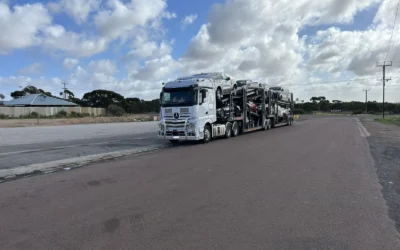
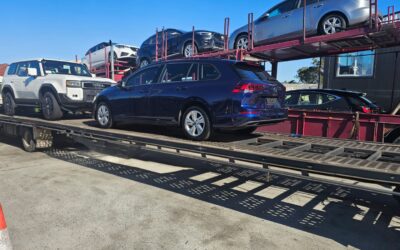
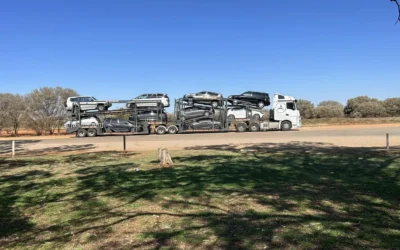
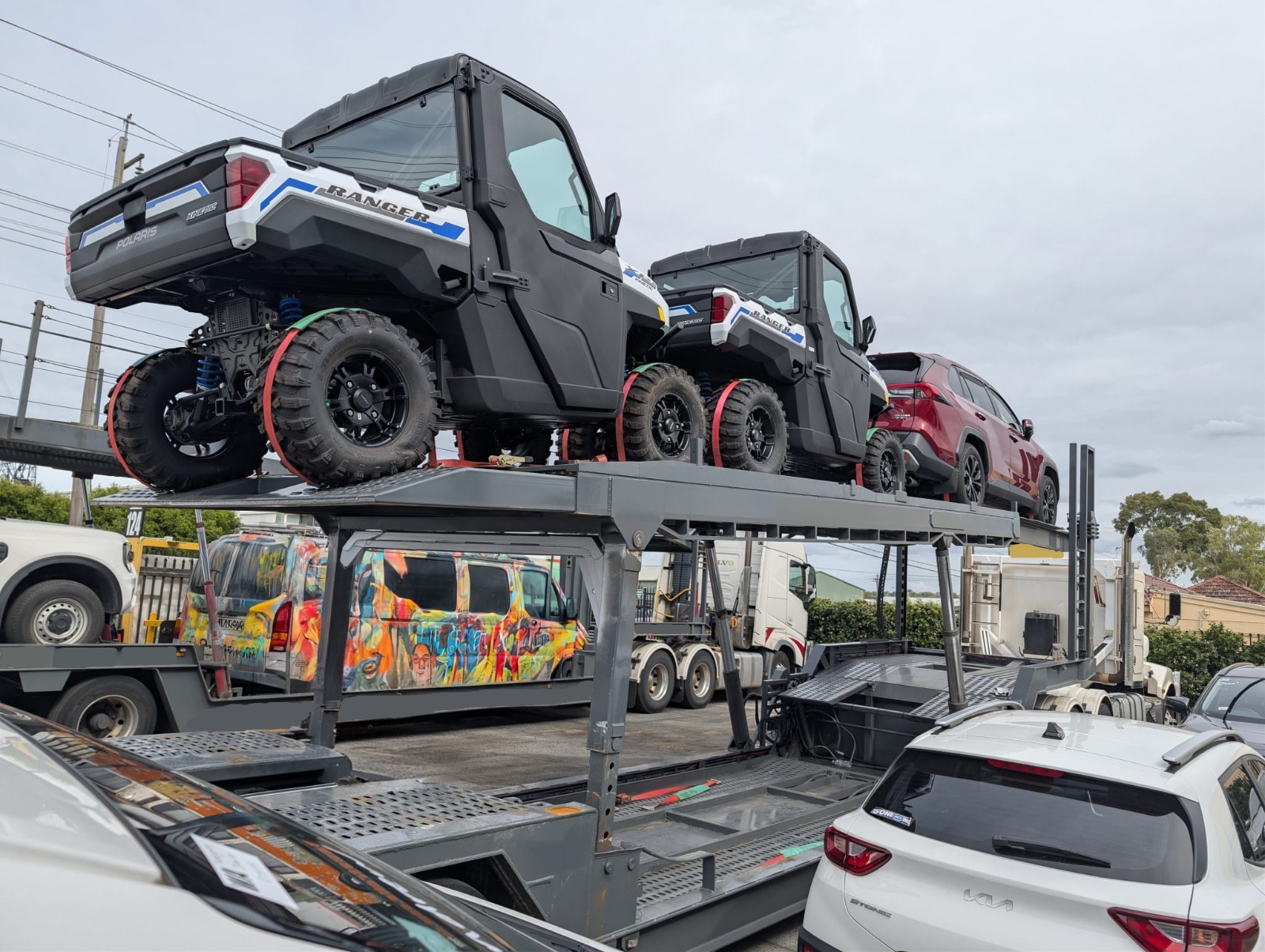
Open car transport is exactly what it sounds like: your vehicle rides on an uncovered, multi-tier trailer — the kind you’ve driven past on the Hume Highway or the Bruce Highway without a second thought. These carriers typically move several vehicles at once, stacked across upper and lower decks.
It’s the backbone of the Australian car-moving industry, and for good reason. Carriers run these routes constantly, and crews secure vehicles using standardised restraint methods rather than guesswork. So for a standard sedan, SUV, or daily-driver ute heading interstate, open transport does exactly what it’s built for — reliably and without drama.
The trade-off is exposure. Your car sits outside the whole trip: rain, road spray, dust, insects, and direct sun. For most vehicles, that’s a non-issue — a quick wash on arrival sorts it out. But for a handful of vehicle types, it’s worth thinking through more carefully, which is exactly what the rest of this article covers.
What Is Enclosed Car Transport?
Enclosed car transport puts your vehicle inside a fully covered, walled trailer. No rain, no UV, no stone chips flicked up from a truck two lanes over. And because the trailer usually carries just one or two vehicles at a time, there’s less shuffling, less handling, and far more attention to how crews position and restrain your car.
Operators generally reserve it for vehicles where exposure is a genuine risk rather than a minor inconvenience — brand-new deliveries, lowered or modified cars, classics and collector vehicles, or anything with limited ground clearance. It’s also the more private option: your car isn’t visible to passing traffic for the whole trip, which matters to plenty of owners regardless of the vehicle.
So if you want the full mechanics of how this plays out — loading equipment, restraint methods, condition reporting — our guide on how luxury cars are transported interstate walks through the process step by step.
Open vs Enclosed Vehicle Transport: A Side-by-Side Comparison
| Factor | Open Transport | Enclosed Transport |
|---|---|---|
| Weather exposure | Full exposure to rain, sun, and road spray | Fully shielded from weather and UV |
| Typical vehicles carried per trip | Multiple (often 6–8) | Usually one or two |
| Best suited to | Daily drivers, dealership stock, standard SUVs and sedans | Modified, lowered, collector, new-delivery, or high-value vehicles |
| Visibility to other road users | Visible in transit | Fully hidden from view |
| Loading method | Standard ramps | Often hydraulic lift gates or low-angle ramps |
| Availability across Australia | Widely available on most interstate routes | More specialised; fewer operators run it |
| Handling and stops | More vehicles on/off at multiple points | Fewer vehicles, generally more direct handling |
So, both methods rely on the same underlying safety standards for securing a vehicle as freight — the real difference is exposure, privacy, and how crews handle the car on the trailer.
Why Australia’s Conditions Actually Make This Decision Matter
This decision doesn’t carry the same weight everywhere in the world. Because of Australia’s size, climate, and road network, the calculation genuinely changes here, for a few concrete reasons.
The Distances Are Long, So Exposure Adds Up
A Perth-to-Sydney run covers roughly the same distance as London to Moscow. So a car on an open carrier for that trip sees far more sun, dust and weather variation than one moving a few hundred kilometres in a smaller country.
Australia’s UV Levels Are Genuinely Extreme
According to the Australian Radiation Protection and Nuclear Safety Agency (ARPANSA), Australia experiences some of the highest UV radiation levels in the world. People usually think of that as a skin-health issue, but it applies to paintwork, plastic trims, and rubber seals too. In other words, prolonged UV exposure is a real factor in paint fade and interior wear over time, especially on a multi-day interstate haul rather than a quick suburban run.
Severe Storms and Hail Aren’t Rare Events Here
The Insurance Council of Australia has repeatedly reported large-scale east-coast storm events generating tens of thousands of motor vehicle insurance claims within a single week, from smashed windscreens through to significant panel damage. Storm season doesn’t always line up neatly with a planned transport booking, though, and an open carrier caught in a serious hail cell offers zero protection.
Remote and Regional Routes Bring Their Own Hazards
Long highway stretches between capital cities mean more exposure to loose gravel, dust from unsealed shoulders, and debris kicked up by road trains — all things an enclosed trailer removes.
None of this means open transport is unsafe. It isn’t — vehicles move safely on open carriers across Australia every single day. It just means the exposure factor matters more here than it would in a smaller or milder-climate country, which is exactly why it’s worth thinking through rather than defaulting to whatever comes to mind first.
How Carriers Actually Secure Vehicles, Regardless of Type
Whichever trailer your car ends up on, the way carriers restrain it follows the same national framework. The National Heavy Vehicle Regulator’s Load Restraint Guide sets out the accepted standards for securing vehicles as freight across Australia, covering tie-down methods and direct restraint systems alike. So reputable operators, open or enclosed, work within this framework rather than improvising.
What differs, instead, is the equipment used to get the car into position. Standard vehicles roll up standard ramps without issue. Lower vehicles, or anything with a front splitter, benefit from hydraulic lift gates or shallow-angle ramps that avoid scraping — a detail that matters more on enclosed transporters, since that’s typically where these vehicles end up.
Which Option Actually Fits Your Situation?
Rather than picking a side in the abstract, it’s better to match the method to the vehicle:
- Everyday sedans, SUVs and utes relocating interstate: open transport, the sensible, well-tested default.
- Dealership stock and fleet vehicles: open transport again, since volume and efficiency matter more than individual exposure here.
- Brand-new vehicles with zero kilometres, including EVs: enclosed transport avoids stone chips and road grime before you’ve even driven it. Moving a new Tesla specifically? Our Tesla transport guide for Australia covers the extra considerations that come with EVs.
- Lowered, modified, or performance vehicles: enclosed, mainly for the ground-clearance and loading-equipment reasons we covered above.
- Classic, collector, or numbers-matching vehicles: enclosed almost every time. Our collector vehicle transport guide explains why originality and provenance make exposure a different kind of risk here.
- Genuinely high-value or prestige vehicles: read our breakdown of how high-value vehicle transport protects luxury and prestige cars before deciding either way.
- Moving during storm season, or on a route with a rough forecast: either way, our guide on preparing a vehicle for rainy season transport is worth a read.
Still unsure? Our broader piece on the safest way to transport a car interstate tackles the decision from a pure safety angle.
Common Myths About Open and Enclosed Transport
“Open transport is dangerous.” Not true. It’s the industry standard for a reason: the same national restraint standards covered above apply to it too. So the risk with open transport isn’t structural — it’s cosmetic exposure to weather and debris.
“Enclosed transport is only for supercars.” Also not true. Plenty of owners choose it simply because they don’t want a brand-new car, or one with sentimental value, sitting exposed on a rough-weather route.
“Every operator offering enclosed transport handles it the same way.” This is the one that trips people up. In fact, capacity, loading equipment, and experience with low-clearance vehicles vary a lot between operators — so it’s worth asking directly rather than assuming.
Insurance: Check It Matches the Vehicle, Not Just the Method
Whichever carrier type you choose, transit insurance is only half the picture — your own policy matters too. This is really an “agreed value” conversation. As Moneysmart, the Australian Government’s financial guidance service, explains, an agreed value policy locks in a set payout figure with your insurer ahead of time, while a market value policy leaves the insurer to work that figure out later. So that distinction matters a lot more once you’re talking about a modified, imported, or genuinely rare vehicle, whichever type of carrier it ends up on.
Questions Worth Asking Before You Book
- Does the operator offer both open and enclosed options, or only one?
- What loading equipment do they use for low-clearance vehicles?
- Is a condition report completed at both pickup and delivery?
- Can you track your vehicle while it’s in transit?
- Does their transit insurance genuinely reflect what your car is worth?
A quick conversation before booking answers all of this — and that’s really the difference between an operator that just moves cars and one that actually thinks about the vehicle in front of them.
Frequently Asked Questions
What’s the actual difference between open and enclosed vehicle transport? Open moves your car on an uncovered, multi-level trailer alongside other vehicles. Enclosed, by contrast, moves it inside a fully covered trailer that blocks out weather and road debris, typically with far fewer vehicles on board.
Is enclosed car transport necessary for a standard family car? Generally, no. A well-run open carrier is a safe, proven option for most everyday vehicles moving around Australia.
Does open transport damage paintwork? Not inherently, but prolonged exposure to Australia’s strong UV levels and road debris over a long interstate route can contribute to fading or minor marking over time.
Can I request enclosed transport for a standard vehicle if I just prefer it? Yes. Plenty of owners choose enclosed purely for peace of mind, even when the vehicle itself wouldn’t strictly need it.
Which option is faster, open or enclosed? Timing depends more on the route, the operator’s schedule, and current demand than on carrier type. So ask your provider directly about expected transit times for your route.
The Bottom Line
Open vs enclosed car transport in Australia isn’t really a debate about which method wins — instead, it’s about matching the method to the vehicle, the route, and how much exposure you’re genuinely comfortable with. Open transport is the reliable, well-proven default for most everyday cars, while enclosed transport earns its place for anything low-clearance, brand-new, modified, or simply too valuable to leave exposed on a multi-day interstate run.
At Unicorn Car Transport, we run both options and help match the right one to your specific vehicle rather than defaulting to whatever’s easiest to schedule. So browse our full range of vehicle transport services, or get in touch with our team to talk through open vs enclosed for your car. Ready to move? Request a quote and we’ll walk you through the right option for your route.